
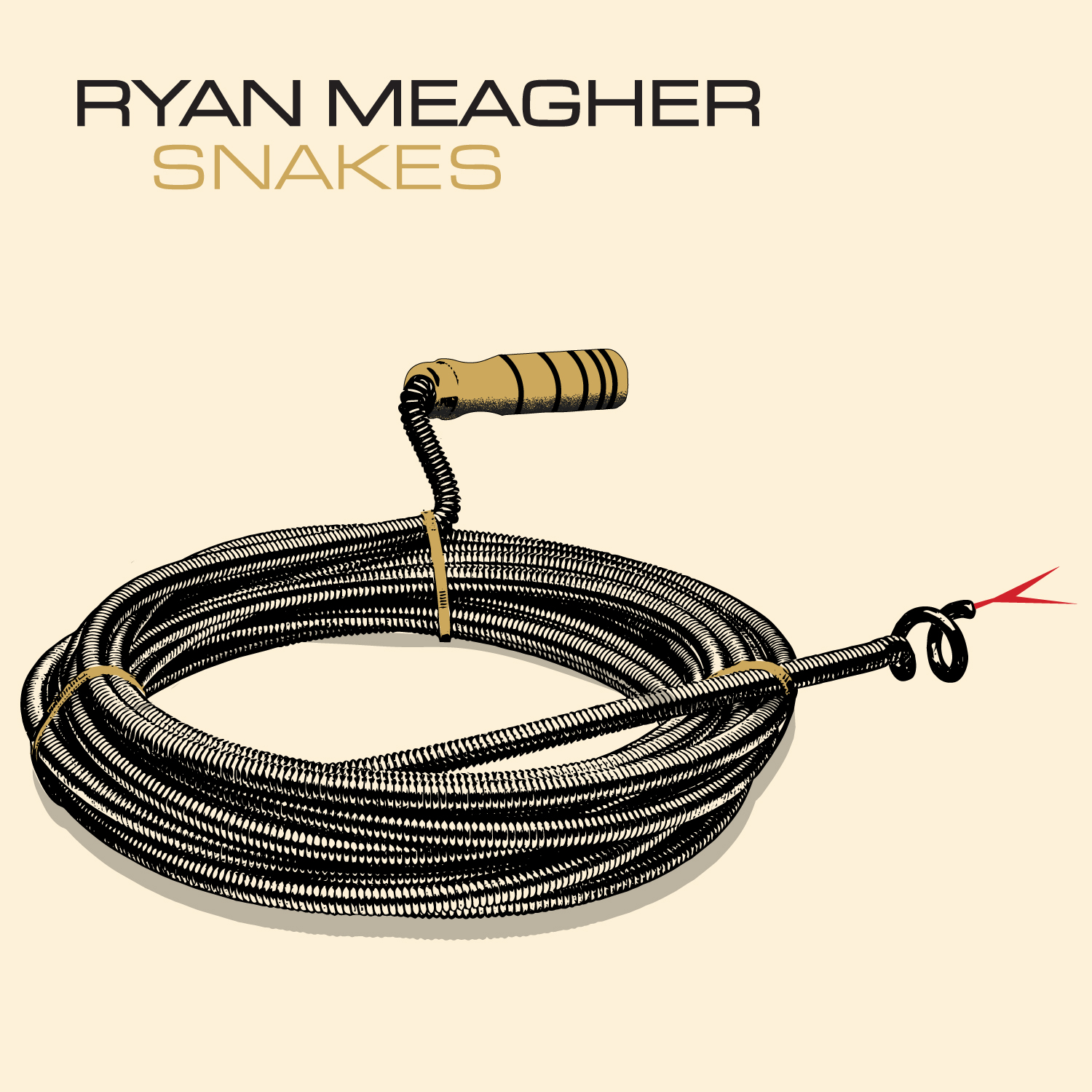
Guitarist/composer Ryan Meagher has never written a tune that wasn’t for somebody, or somewhere. Snakes, his new album on PJCE Records, is a seven-track set that moves from hard swing, to slow-burn, and raucous rock while maintaining its venom. Most of the record was cut in the studio in Portland, while the rest was caught live at The 1905. Meagher is bringing it full circle by launching the album not at home, but at Small’s in New York City, the club scene where he cut his teeth as a young player two decades ago.
Meagher has again surrounded himself with some serious firepower to bring these tunes to life. On tenor saxophone is Noah Preminger, a two-time DownBeat Rising Star Best Tenor Saxophonist and a bandleader with nearly two dozen acclaimed albums of his own, who has shared bandstands with Jason Moran, Dave Holland, Fred Hersch, and Joe Lovano. Alongside him on piano is George Colligan, a DownBeat Critics Poll winner whose credits run from Jack DeJohnette to John Scofield to Cassandra Wilson across more than 150 recordings. Rounding out the rhythm section, bassist Michael Feinberg, who has recorded and toured with Billy Hart, Dave Liebman, and Ambrose Akinmusire, locks in with drummer Jonathan Pinson, who landed a touring chair with Herbie Hancock and Wayne Shorter at just 23 and trained at Berklee and the Thelonious Monk Institute at UCLA. Saxophonist Joe Manis, a SteepleChase recording artist and Oregon Arts Commission Fellow, sits in on the album’s live centerpiece.
Meagher’s own resume holds its own against the company he keeps. He has cut three albums, Atroefy, Tone, and Lost Days, for the influential Fresh Sound New Talent label. The same Spanish imprint that gave early career boosts to Brad Mehldau, Kurt Rosenwinkel, and Robert Glasper. JazzTimes called his writing “startlingly original stuff,” and DownBeat has singled out the folk-song character running through his melodic sense. He puts in at least as much work off of the bandstand as on it. Meagher is Artistic Director of the Portland Jazz Composers Ensemble and director of its label, PJCE Records; co-founder of the Montavilla Jazz Festival; Festival Coordinator of the Mt Hood Jazz Festival; and Director of Jazz Programs at Lower Columbia College, in addition to teaching guitar at Mt Hood Community College, the University of Portland, Portland State University, and Willamette University. Few working guitarists carry this much of their scene on their back while still finding time to write, record, and lead a band this sharp.
“When I write tunes, I want them to stand on their own, amazing jazz solos on them or not,” Meagher says. “For me, it starts with the tune. And tunes for me start with people and places.” That philosophy runs through every track on Snakes: “Rope Burn” was written as a tribute to formative influences Peter Epstein and Ralph Alessi, “Bruiser” takes its name from a favorite steelhead run on Oregon’s Clackamas River, and “Uncle Paul” is an elegy for the uncle who first put a guitar in Meagher’s hands. The live cut “Pillage a Village,” recorded at The 1905 with Preminger and Manis trading fire over a droning vamp, captures the record’s rawest moments, proof that for all its craft, Snakes is built to bite.
Album Liner Notes from Ryan Meagher
The two things that have always driven me to compose music are people and places. I hardly ever write music without either of those things being the inspiration for a piece. I remember one of my professors many years ago asking our jazz composition class the question, “Why do we write a jazz tune?” The answer he was looking for was, “So we have something to play.” Ever the thorn in my teachers’ sides, I started pushing back against this idea. I have a different view of jazz composition. When I write tunes, I want them to stand on their own, amazing jazz solos on them or not. I feel that many of my favorite jazz composers must have felt similarly. Sometimes, I don’t even want to hear anyone improvise on “Pannonica,” or “Isfahan,” or “Question and Answer.” Of course, it’s great when a master improviser takes a beautiful tune like those, makes it their own, and goes to new places. But for me, it starts with the tune. And tunes for me start with people and places.
The name of the album is derived from two inside jokes. First, the opening track, “Snakin’ It,” which got its title from my jazz musician nerd group chat about how we do our fantasy baseball draft. It also comes from a decades long inside joke that started with my first friend group when I moved to New York City in 2003. I wrote “Snakin’ It” for the fantasy baseball league a couple years ago, and since Noah Preminger and Michael Feinberg are in the league, I knew it had to go on this album.
“The Boss” was not written for Bruce Springsteen. I don’t know much, if anything about his music, and I famously hate his drummer who twice tried to get me fired when I worked on Late Night with Conan O’Brien. That’s a fun story I love to tell, so buy me a drink at the next gig and I’ll dish the dirt. I wrote “The Boss,” for my friend, Douglas Detrick, when he was leaving the Portland Jazz Composers Ensemble as Executive Director. He and I have been through a lot together pulling this little organization around as much as we could for over a decade. This is my tribute to him, and it premiered at the first ever musical performance at the Patricia Reser Center for the Arts.
“Rope Burn” was a tune that I wrote for both Peter Epstein and Ralph Alessi. They are both profound musical influences on me, and whenever I have had the chance to play music with them, it feels too good to be true. It’s truly an honor and privilege to know them and have had the chance to play with them over the years.
I wrote “Pillage a Village” for Noah and Joe Manis just before we recorded this tune live at the 1905 in Portland. Noah and Joe go way back. They both have great sounds and play crazy shit. And I wanted something that would lay the groundwork for them to come in and burn the place down. I figured a G drone would do the trick.
“Bruiser” was written for a place, believe it or not. This tune was originally on my fly-fishing-inspired suite, A Thousand Casts. Bruiser is the name of one of the runs where migrating steelhead will hole up on the Clackamas river. It got its name because the guide who took me there once caught a real big bruiser of a hen steelhead on that run. A little on the nose, but the title works.
“Mongoose of Damascus” got its title from a really dumb inside joke with another group of friends. It’s too long of a story to tell with not a lot of payout. The tune title has nothing to do with the animal or the city in Syria. But since the album is called Snakes, and mongooses eat snakes, let’s go with that.
“Uncle Paul,” was written for my Uncle Paul. It’s not that complicated. He was the one who really got me into music. A criminally underrated rock singer and good guitar player in his own right, it’s hard not to call Uncle Paul my first musical influence. I wrote this for him when he was battling cancer, to which he eventually succumbed. Undoubtedly one of the most rock and roll figures I’ve met in my life.
Album Details
Artist: Ryan Meagher
Title: Snakes
Personnel: Ryan Meagher – guitar; Noah Preminger – tenor saxophone; George Colligan – piano; Michael Feinberg – acoustic bass, electric bass tracks 3 and 5; Jonathan Pinson – drums; Joe Manis – tenor saxophone, track 4
Track listing: Run time:
Snakin’ It 6:04
The Boss 6:11
Rope Burn 7:44
Pillage a Village [LIVE] 12:57
Bruiser 9:41
Mongoose of Damascus [LIVE] 7:43
Uncle Paul 7:43
Total Run Time: 58:08
Composer Credits: all compositions by Ryan Meagher, BMI
Studio tracks recorded by: Clay Giberson at Gyberspace in Portland, OR on June 11, 2025
Live tracks recorded by: M Keefe Rayfield at The 1905 in Portland, OR on June 11, 2025
Mixed by: Andrew Jones
Mastered by: Dana White at Specialized Mastering in Portland, OR
Executive Producer: Ryan Meagher
Art design by: Dylan Marcus McConnell at Tiny Little Hammers
PJCER 075
BIO
Guitarist and composer Ryan Meagher (pronounced Marr) blends sharp compositional vision with fearless improvisational energy. Emerging from the New York jazz scene in the 2000s, Meagher relocated to Portland, quickly becoming a key figure in the region’s dynamic music ecosystem. Beyond leading his own ensembles and releasing critically acclaimed albums on Fresh Sound New Talent and PJCE Records, Meagher is a dedicated community builder. He is the Artistic Director of the Portland Jazz Composers Ensemble (PJCE), Director of PJCE Records, and a jazz educator with appointments at Portland State University, Willamette University, Mount Hood Community College, University of Portland, and Lower Columbia College. Whether sharing the stage with icons like Randy Brecker, David Friesen, and Cuong Vu or helming regional festival programming, Meagher remains one of the Northwest’s most versatile champions of modern jazz.